Journal of Clinical and Biomedical Sciences
DOI: 10.58739/jcbs/v16i2.24.71
Year: 2026, Volume: 16, Issue: 2, Pages: 58-60
Case Report
Hussain Kolsawala1*, T S Rajashekar 2
1Junior resident doctor, Department of Dermatology, Sri Devaraj Urs Medical College, Tamaka, Kolar.
2Professor and HOD, Department of Dermatology, Sri Devaraj Urs Medical College, Tamaka, Kolar.
*Corresponding Author
Email: [email protected]
Received Date:19 July 2024, Accepted Date:12 August 2024, Published Date:15 June 2026
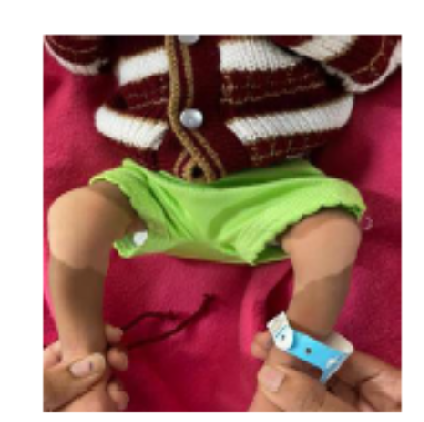
Introduction: Waardenburg syndrome is an autosomal dominant inherited genetic condition where abnormal melanocyte distribution during embryogenesis results in areas of patchy depigmentation. The loss of pigmentary cells in skin, eyes, hair and stria vascularis of cochlea are the cause of various clinical manifestations of this syndrome. The incidence of this syndrome globally is 1/42000 live births. Case Report: One day old male baby presented with symmetrical depigmented patches over both lower legs, white forelock, hearing loss, broad nasal bridges since birth. Baby was delivered at 37 weeks period of gestation after an uneventful pregnancy through normal vaginal delivery; history of similar complaints in the father present. No h/o consanguinity among parents. On Examination: Symmetrical solitary well defined depigmented patches of size 4x5cm present over both lower legs around knee joints. White forelock present over the frontal region of head. Broad nasal bridge with heterochromia of eyes present. Sensorineural hearing loss detected after audiometry test. Hence clinically diagnosed as Waardenburg syndrome type II. Conclusion: This is a rare case of Waardenburg syndrome satisfying criteria for type II. Knowledge of this syndrome helps in its early identification and diagnosis which in turn helps in its early management.
Keywords: Waardenburg Syndrome, White Forelock, Depigmented Patches
1. Chandra Mohan SLN. Case of Waardenburg Shah syndrome in a family with review of literature. Journal of Otology. 2018; 13 (3). Available from: https://doi.org/10.1016/j.joto.2018.05.005
2. Saleem MD. Biology of human melanocyte development, Piebaldism, and Waardenburg syndrome. Pediatric Dermatology. 2019; 36 (1). Available from: https://doi.org/10.1111/pde.13713
3. Ringer J. Identification of Waardenburg Syndrome and the Management of Hearing Loss and Associated Sequelae: A Review for the Pediatric Nurse Practitioner. Journal of Pediatric Health Care. 2019; 33 (6). Available from: https://doi.org/10.1016/j.pedhc.2019.06.001
4. Liu Q, Cheng J, Lu Y, Zhou J, Wang L, Yang C, <I>et al</I>. The clinical and genetic research of Waardenburg syndrome type I and II in Chinese families. International Journal of Pediatric Otorhinolaryngology. 2020; 130 Available from: https://doi.org/10.1016/j.ijporl.2019.109806
5. Que SK, Weston G, Suchecki J, Ricketts J. Pigmentary disorders of the eyes and skin. Clinics in Dermatology. 2015; 33 (2). Available from: https://doi.org/10.1016/j.clindermatol.2014.10.007
This is an open-access article distributed under the terms of the Creative Commons Attribution License, which permits unrestricted use, distribution, and reproduction in any medium, provided the original author and source are credited.
Published By Sri Devaraj Urs Academy of Higher Education, Kolar, Karnataka
Subscribe now for latest articles and news.