Journal of Clinical and Biomedical Sciences
DOI: 10.58739/jcbs/v16i2.25.141
Year: 2026, Volume: 16, Issue: 2, Pages: 9-15
Original Article
Sangeeta Datta1, Avinash Kumar2*, Biswaroop Chatterjee3
1Junior Resident, Department of Microbiology, IQ City Medical College and Hospital, Durgapur-713206, West Bengal, India.
2Associate Professor, Department of Microbiology, IQ City Medical College and Hospital, Durgapur-713206, West Bengal, India.
3Professor, Department of Microbiology, IQ City Medical College and Hospital, Durgapur-713206, West Bengal, India.
*Corresponding Author
Email: [email protected]
Received Date:25 March 2025, Accepted Date:11 April 2026, Published Date:15 June 2026
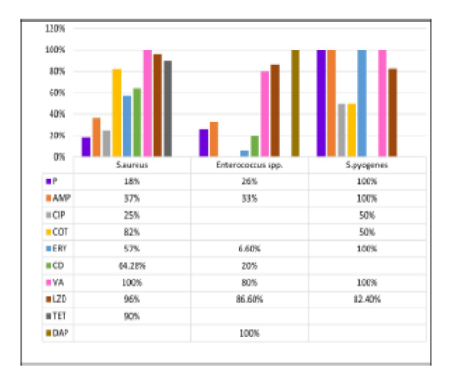
Introduction: Pyogenic infections are caused by a variety of microorganisms. Routine surveillance is essential to monitor the distribution and evolving susceptibility patterns of clinically significant pathogens over time. This study aims to highlight the bacteriological profile of pus samples and analyse their antimicrobial susceptibility patterns at a tertiary-care hospital in Eastern India. Methods: This was a retrospective study covering an eighteen months period from May 2023 to October 2024. A total of 428 pus samples were included. The samples were inoculated onto Blood, Chocolate and MacConkey agar plates and incubated. Bacteria were identified and tested for antimicrobial susceptibility using an automated system. Results: Culture-positivity was 88%, in which Gram-negative (GN) bacteria (58%) outnumbered Gram-positives (GP) (42%). The highest number of samples was obtained from patients with skin and soft tissue infections (40%). Overall, Staphylococcus aureus was found to be the most prevalent pathogen (29%). Among GN, Pseudomonas aeruginosa was predominant (16.4%). GP isolates were most often susceptible to vancomycin (94%) and linezolid (88.3%). Methicillin-resistant Staphylococcus aureus (MRSA) was 44.4% and vancomycin-resistant Enterococci (VRE) was 20%. Enterobacterales demonstrated a high susceptibility to colistin (80%) and tigecycline (78.5%). ESBL-producing Enterobacterales (ESBL-E) positivity was 48.2% and Carbapenem resistance Enterobacterales (CRE) was 44%. All isolates of Acinetobacter calcoaceticus-baumannii complex and 33.3% of Pseudomonas aeruginosa isolates were multi-drug resistant (MDR), demonstrating maximum susceptibility to colistin. Conclusion: Emergence of resistant strains are the significant concerns of this study. Effective infection control practices and proper antimicrobial stewardship are the utmost needs of the hour.
Keywords: Pus, Bacteriological profile, Antimicrobial susceptibility, Multidrug resistance, MRSA, ESBL
1. Murugesan K, Radha RS, Vijayan H. Study on Antimicrobial Susceptibility Testing against Pyogenic Organisms from Wound Infections. <I>International Journal of Pharmaceutical Sciences Review and Research</I>. 2017;45(1):262–5.
2. Zabaglo M, Leslie SW, Sharman T. <I>Postoperative Wound Infections</I>. [Updated 2024 Mar 5]. In: StatPearls [Internet]. Treasure Island (FL): StatPearls Publishing; 2024 Jan. Available from: https://www.ncbi.nlm.nih.gov/books/NBK560533/
3. Laxminarayan R, Chaudhury RR. Antibiotic Resistance in India: Drivers and Opportunities for Action. PLOS Medicine. 2016; 13 (3). Available from: https://doi.org/10.1371/journal.pmed.1001974
4. Antimicrobial Resistance Collaborators. Global burden of bacterial antimicrobial resistance in 2019: a systematic analysis. Lancet. 2022; 399 (10325). Available from: https://doi.org/0.1016/S0140-6736(21)02724-0
5. Mave V, Chandanwale A, Kagal A, Khadse S, Kadam D, Bharadwaj R, <I>et al</I>. High Burden of Antimicrobial Resistance and Mortality Among Adults and Children With Community-Onset Bacterial Infections in India. The Journal of Infectious Diseases. 2017; 215 (8). Available from: https://doi.org/10.1093/infdis/jix114
6. Trojan R, Razdan L, Singh N. Antibiotic Susceptibility Patterns of Bacterial Isolates from Pus Samples in a Tertiary Care Hospital of Punjab, India. International Journal of Microbiology. 2016; 2016 Available from: https://doi.org/10.1155/2016/9302692
7. Deboral A, Bhosale NK, Umadevi S. Aerobic Bacteriological and Antibiotic Susceptibility Profile of Pus Isolates from A Tertiary Care Hospital, Puducherry. Journal of Pure and Applied Microbiology. 2020; 14 (3). Available from: https://doi.org/10.22207/jpam.14.3.35
8. Veeraraghavan B, Walia K. Antimicrobial susceptibility profile & resistance mechanisms of Global Antimicrobial Resistance Surveillance System (GLASS) priority pathogens from India. Indian Journal of Medical Research. 2019; 149 (2). Available from: https://doi.org/10.4103/ijmr.ijmr_214_18
9. Tamma PD, Heil EL, Justo JA, Mathers AJ, Satlin MJ, Bonomo RA. Infectious Diseases Society of America 2024 Guidance on the Treatment of Antimicrobial-Resistant Gram-Negative Infections. Clinical Infectious Diseases. 2024; Available from: https://doi.org/10.1093/cid/ciae403
10. Kursheed F, Tabassum A, Farwa U, Wazir S, Shafiq M, Sheikh AK. The antibiogram of pus cultures in federal tertiary care hospital, Islamabad and its utility in antimicrobial stewardship. Iranian Journal of Microbiology. 2024; 16 (1). Available from: https://doi.org/10.18502/ijm.v16i1.14871
11. Wadekar MD, Sathish JV, Jayashree, Pooja C. Bacteriological profile of pus samples and their antibiotic susceptibility pattern. Indian Journal of Microbiology Research. 2020; 7 (1). Available from: https://doi.org/10.18231/j.ijmr.2020.010
12. Biradar A, Farooqui F, Prakash R, Khaqri SY, Itagi I. Aerobic bacteriological profile with antibiogram of pus isolates. Indian Journal of Microbiology Research. 2016; 3 (3). Available from: https://doi.org/10.5958/2394-5478.2016.00054.6
13. Kalita JM, Nag VL, Kombade S, Yedale K. Multidrug resistant superbugs in pyogenic infections: a study from Western Rajasthan, India. <I>Pan African Medical Journal</I>. 2021;38:409.
14. Subha M, Srinivasagam M. Microbial Profile and Antimicrobial Susceptibility Pattern of Pus Culture Isolates from a Teaching Tertiary Care Hospital, South India. International Journal of Current Microbiology and Applied Sciences. 2018; 7 (04). Available from: https://doi.org/10.20546/ijcmas.2018.704.126
15. Rai S, Yadav UN, Pant ND, Yakha JK, Tripathi PP, Poudel A, <I>et al</I>. Bacteriological Profile and Antimicrobial Susceptibility Patterns of Bacteria Isolated from Pus/Wound Swab Samples from Children Attending a Tertiary Care Hospital in Kathmandu, Nepal. International Journal of Microbiology. 2017; 2017 Available from: https://doi.org/10.1155/2017/2529085
16. Rajkumar S, Sistla S, Manoharan M, Sugumar M, Nagasundaram N, Parija SC, <I>et al</I>. Prevalence and Genetic Mechanisms of Antimicrobial Resistance in <I>Staphylococcus</I> Species: A Multicentre Report of the Indian Council of Medical Research Antimicrobial Resistance Surveillance Network. Indian Journal of Medical Microbiology. 2017; 35 (1). Available from: https://doi.org/10.4103/ijmm.ijmm_16_427
17. Honnegowda TM, Kumar P, Udupa P, Rao P. Epidemiological study of burn patients hospitalised at a burns centre, Manipal. International Wound Journal. 2019; 16 (1). Available from: https://doi.org/10.1111/iwj.12995
18. Roy S, Mukherjee P, Kundu S, Majumder D, Raychaudhuri V, Choudhury L. Microbial infections in burn patients. Acute and Critical Care. 2024; 39 (2). Available from: https://doi.org/10.4266/acc.2023.01571
19. Bessa LJ, Fazii P, Giulio DM, Cellini L. Bacterial isolates from infected wounds and their antibiotic susceptibility pattern: some remarks about wound infection. International Wound Journal. 2015; 12 (1). Available from: https://doi.org/10.1111/iwj.12049
20. Mudassar S, Khan SW, Ali M, Mahmood F. Aerobic Bacteriological Profile and Antimicrobial Susceptibility Pattern of Pus isolates in a Teaching Hospital, Lahore, Pakistan. International Journal of Contemporary Medical Research [IJCMR]. 2018; 5 (4). Available from: https://doi.org/10.21276/ijcmr.2018.5.4.8
21. Sudhaharan S, Kanne P, Chavali P, Vemu L. Aerobic bacteriological profile and antimicrobial susceptibility pattern of pus isolates from tertiary care hospital in India. The Journal of Infection in Developing Countries. 2018; 12 (10). Available from: https://doi.org/10.3855/jidc.10473
22. Gill MK, Sharma S. Bacteriological profile and antibiotic sensitivity patterns of aerobic pus isolates: A study conducted in tertiary care hospital of North India. IP International Journal of Medical Microbiology and Tropical Diseases. 2019; 5 (2). Available from: https://doi.org/10.18231/j.ijmmtd.2019.021
23. Walia K, Madhumathi J, Veeraraghavan B, Chakrabarti A, Kapil A, Ray P, <I>et al</I>. Establishing Antimicrobial Resistance Surveillance & Research Network in India. Indian Journal of Medical Research. 2019; 149 (2). Available from: https://doi.org/10.4103/ijmr.ijmr_226_18
24. Soniya, Umesh, Singh H. Detection of Extended-Spectrum Beta-Lactamase (ESBL) Producing Entrobacteriaceae from Pus Samples and Antimicrobial Co-Resistance in a Tertiary Care Hospital, Uttarakhand. <I>Annals of International Medical and Dental Research</I>. 2020;6(3):ME20- ME24.
25. Farooq L, Memon Z, Ismail MO, Sadiq S. Frequency and antibiogram of multi-drug-resistant <I>Pseudomonas aeruginosa</I> in a Tertiary Care Hospital of Pakistan. Pakistan Journal of Medical Sciences. 2019; 35 (6). Available from: https://doi.org/10.12669/pjms.35.6.930
26. Mutai N, Olwande M, Gichuki JW, Revathi G. Molecular epidemiology and antimicrobial resistance of Staphylococcus aureus isolates from clinical specimens in a tertiary hospital in Kenya. <I>BMC Infectious Diseases</I>. 2022;22(1):301.
This is an open-access article distributed under the terms of the Creative Commons Attribution License, which permits unrestricted use, distribution, and reproduction in any medium, provided the original author and source are credited.
Published By Sri Devaraj Urs Academy of Higher Education, Kolar, Karnataka
Subscribe now for latest articles and news.