Journal of Clinical and Biomedical Sciences
DOI: 10.58739/jcbs/v16i2.25.311
Year: 2026, Volume: 16, Issue: 2, Pages: 31-35
Original Article
Prabhjot Kaur Gill1*, Amandeep Singh2
1Professor, Centre for Advanced Research and Development (Genetics, SGRDIMSR), Sri Guru Ram Das University of Health Sciences, Sri Amritsar, 143501, Punjab, India.
2Ph.D. Scholar, Centre for Interdisciplinary Biomedical Research, Adesh University, Bathinda, Punjab, India.
*Corresponding Author
Email: [email protected]
Received Date:04 August 2025, Accepted Date:27 April 2025, Published Date:15 June 2026
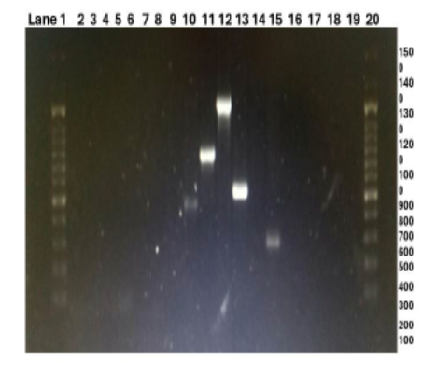
Objectives: The present study focused on the molecular identification and evaluation of specific gene targets for the rapid and accurate detection of Salmonella typhi from blood samples of patients diagnosed with typhoid fever. Methodology: Three representative isolates were subjected to 16S rRNA gene sequencing, and their identity as S. typhi was confirmed via BLASTn analysis with 100% sequence identity and query coverage. To develop a DNA-based diagnostic tool, single gene-target PCR assays were optimized using six primer sets targeting STY2020, STY2021, STY0201, STY0307, STY0322, and STY0326. Results: Five of these assays successfully identified all S. typhi isolates with 100% sensitivity and specificity, while the STY0322 assay failed to amplify any strains. Detection limit analysis using serially diluted genomic DNA revealed that STY0307 was the most sensitive target (5.0 pg), followed by STY0201 and STY2021 (10 pg). Lower sensitivity was observed with STY2020 and STY0326 (50 pg), with only faint gel electrophoresis bands. These results indicate that STY0307, STY0201, and STY2021 are highly reliable markers for S. typhi detection. Furthermore, low expression levels of STY2020 and STY0326 during infection underscore the need for further population-based studies. Conclusion: STY0307 and STY2021 emerged as the most promising gene targets for diagnostic purposes and could be leveraged for the development of low-cost, rapid, and accurate point-of-care diagnostics suitable for use in resource-limited settings.
Keywords: Diagnostic tool, Gene-specific markers, PCR assay, Salmonella typhi, Typhoid fever
1. Reddy EA, Shaw AV, Crump JA. Community-acquired bloodstream infections in Africa: a systematic review and meta-analysis. The Lancet Infectious Diseases. 2010; 10 (6). Available from: https://doi.org/10.1016/s1473-3099(10)70072-4
2. Deen J, von Seidlein L, Andersen F, Elle N, White NJ, Lubell Y. Community-acquired bacterial bloodstream infections in developing countries in south and southeast Asia: a systematic review. The Lancet Infectious Diseases. 2012; 12 (6). Available from: https://doi.org/10.1016/s1473-3099(12)70028-2
3. Feasey NA, Dougan G, Kingsley RA, Heyderman RS, Gordon MA. Invasive non-typhoidal Salmonella disease: an emerging and neglected tropical disease in Africa. The Lancet. 2012; 379 (9835). Available from: https://doi.org/10.1016/s0140-6736(11)61752-2
4. Panwar S, Duggirala KS, Yadav P, Debnath N, Yadav AK, Kumar A. Advanced diagnostic methods for identification of bacterial foodborne pathogens: contemporary and upcoming challenges. Critical Reviews in Biotechnology. 2023; 43 (7). Available from: https://doi.org/10.1080/07388551.2022.2095253
5. Prabagaran SR, Kalaiselvi V, Chandramouleeswaran N, Deepthi KNG, Brahmadathan KN, Mani M. Molecular diagnosis of Salmonella typhi and its virulence in suspected typhoid blood samples through nested multiplex PCR. Journal of Microbiological Methods. 2017; 139 Available from: https://doi.org/10.1016/j.mimet.2017.05.013
6. Mustafa AH, Raad AZ. Molecular identification of CdtB and TviA virulence genes of Salmonella typhi isolated from cholelithiasis patients in Erbil City, Iraq. Journal of Applied and Natural Science. 2024; 16 (4). Available from: https://doi.org/10.31018/jans.v16i4.5922
7. Faik AJ, Al-wardy AH, Mohammad RE. Multiplex PCR for identification of Salmonella enterica serovars Typhi and Paratyphi A by selective amplification of tyv, prt, viaB, fliC-d and fliC-a genes. Journal of Biotechnology Research Center. 2014; 8 (2). Available from: https://doi.org/10.24126/jobrc.2014.8.2.333
8. Wan Makhtar WR, Bharudin I, Samsulrizal NH, Yusof NY. Whole genome sequencing analysis of Salmonella enterica serovar Typhi: history and current approaches. Microorganisms. 2021; 9 (10). Available from: https://doi.org/10.3390/microorganisms9102155
9. Maes M, Sikorski MJ, Carey ME, Higginson EE, Dyson ZA, Fernandez A, et al. Whole genome sequence analysis of Salmonella typhi provides evidence of phylogenetic linkage between cases of typhoid fever in Santiago, Chile in the 1980s and 2010–2016. PLoS Neglected Tropical Diseases. 2022; 16 (6). Available from: https://doi.org/10.1101/2022.01.19.22269577
10. Goay YX, Chin KL, Tan CL, Yeoh CY, Ja’afar JA, Zaidah AR, et al. Identification of Five Novel Salmonella typhi ‐Specific Genes as Markers for Diagnosis of Typhoid Fever Using Single‐Gene Target PCR Assays. BioMed Research International. 2016; 2016 Available from: https://doi.org/10.1155/2016/8905675
11. Avneet Kaur Heyar, Kamaldeep Kaur, Amarjit Kaur Gill, Prabhjot Kaur Gill. Induction of clindamycin resistance in clinical isolates of Staphylococcus aureus from a tertiary care hospital. International Journal of Medical and Biomedical Studies. 2020; 4 (12). Available from: https://doi.org/10.32553/ijmbs.v4i12.1566
12. Ngan GJ, Ng LM, Lin RT, Teo JW. Development of a novel multiplex PCR for the detection and differentiation of Salmonella enterica serovars Typhi and Paratyphi A. Research in Microbiology. 2010; 161 (4). Available from: https://doi.org/10.1016/j.resmic.2010.03.005
13. Pratap CB, Kumar G, Patel SK, Verma AK, Shukla VK, Kumar K, et al. Targeting of putative fimbrial gene for detection of S. typhi in typhoid fever and chronic typhoid carriers by nested PCR. The Journal of Infection in Developing Countries. 2013; 7 (07). Available from: https://doi.org/10.3855/jidc.2561
14. Tracz DM, Tabor H, Jerome M, Ng LK, Gilmour MW. Genetic determinants and polymorphisms specific for human-adapted serovars of Salmonella enterica that cause enteric fever. Journal of Clinical Microbiology. 2006; 44 (6). Available from: https://doi.org/10.1128/jcm.02630-05
This is an open-access article distributed under the terms of the Creative Commons Attribution License, which permits unrestricted use, distribution, and reproduction in any medium, provided the original author and source are credited.
Published By Sri Devaraj Urs Academy of Higher Education, Kolar, Karnataka
Subscribe now for latest articles and news.